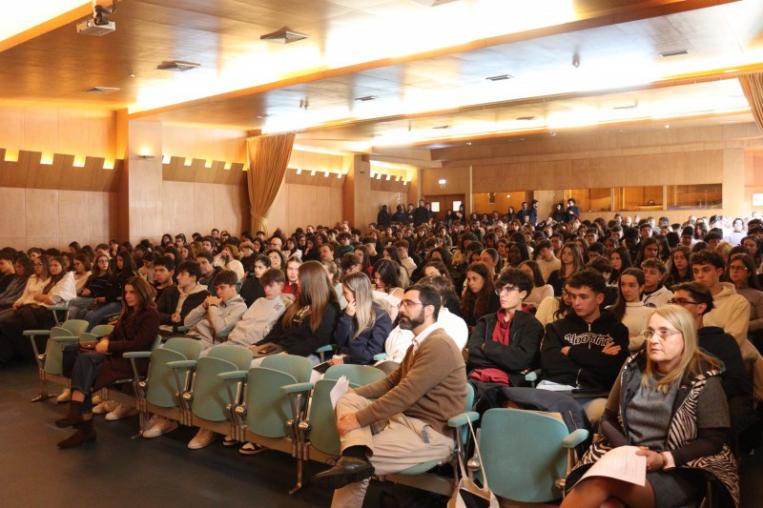
World Philosophy Day was celebrated yesterday at the Faculty of Philosophy and Social Sciences of the Braga Regional Centre of the Catholic University. The initiative brought together around 300 students from various secondary schools in the region.
‘Philosophy is important for the future of the world’ and continues to be ‘an antidote to all the mishaps of history that diminish our humanity.’ The message was left yesterday by Bruno Nobre, director of the Faculty of Philosophy and Social Sciences (FFCS) of the Portuguese Catholic University - Regional Centre of Braga, during the celebration of World Philosophy Day. The theme chosen for this year was “Our attention today”, emphasising the urgency of thinking, caring for and educating this essential skill for personal, school and social life, in an environment increasingly marked by digital distractions.
The initiative brought together around 300 students from the Barcelos School Group, the Maximinos School Group, the Dom Diogo de Sousa College and the Martins Sarmento School in Guimarães.
"Philosophy is a discipline that encourages critical and independent thinking and works towards a better understanding of the world and promotes tolerance and peace. So philosophy is important for young people, philosophy is really important for the future of the world, and that is what we are celebrating here," the director emphasised to the young students, recalling a recent interview with Daniela Braga, founder and CEO of Defined.ai, the most recognised Portuguese company in the world of Artificial Intelligence.
‘We have all realised that Artificial Intelligence is changing our world, changing our relationship with each other, our relationship with the whole world, the way we learn. And note what Daniela Braga says: it will be better to study philosophy than programming. In future generations, those who will be most successful are precisely those who can understand the human component,’ quoted Bruno Nobre.
As he pointed out, understanding the human component is philosophy's main weapon and, therefore, ‘those who understand the human component will be more successful than those who live solely in relation to technology.’