In the opening session of this congress, which highlighted the need for regulation of Artificial Intelligence (AI), the Vice-Chancellor of UCP – Braga, Paulo Dias, stressed that although technology broadens horizons and democratises access to knowledge, it also creates vulnerabilities, namely “dependence on algorithms” and “pressure for constant performance”. Paulo Dias highlighted the importance of this conference resulting in ‘ethical, educational, social and political reflection on the impact of digital technology on our lives.’ The Director of FFCS, Bruno Nobre, also recalled that Ignatian pedagogy offers valuable tools for reflecting on the educational challenges arising from the use of AI.
The coordinator of the Congress Organising Committee, José Lopes, SJ, warned of the risks of Artificial Intelligence (AI) to human development and the common good. According to José Lopes, we must be aware that ‘AI can hinder or even oppose human development and the common good, prolonging situations of marginalisation and discrimination, creating new forms of poverty, widening the digital divide and exacerbating social inequalities’. He also stressed that AI can ‘manipulate consciousness and influence the democratic process for the benefit of a few’ and promote a ‘technocratic paradigm’ that suggests that all the world's problems can be solved solely by technological means. He also stressed that ‘the use of AI cannot distance or isolate its users from this purpose in the educational process, and cannot lead to social disintegration, misinformation, the legitimisation of fake news or cases of AI hallucination’.
Over the course of three days, the conference addressed various topics, including educational policy, digital communication and learning; human reconfigurations resulting from digital technology; virtualisation of community spaces, flows and sense of belonging; digital citizenship, activism and power; and spirituality and Ignatian pedagogy in the face of the digital challenge. The event featured three plenary speakers: Mathieu Guillermin, from the Université Catholique de Lyon, with the lecture ‘Human and Artificial Intelligence: Similarities and Divergences’; Afonso Seixas Nunes, SJ, from the University of Saint Louis School of Law, who discussed ‘AI and the Structural Problem: We Don't Know What We Don't Know’; and finally, Paulo Novais, from the University of Minho, with ‘(Re)Building the Future of Education: AI as Support for More Personalised and Inclusive Learning’.
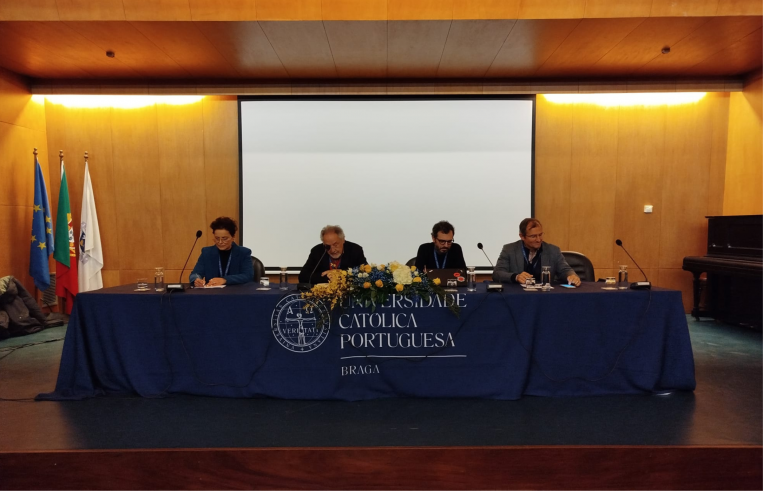
Several thematic panels were also held, bringing together academics, professionals, and institutional representatives: on the 22nd, ‘The Future of Homo Digitalis: Dream or Nightmare?’, with João Manuel Duque (Faculty of Theology-UCP), Luís Parreirão (Administrator of the Manuel António da Mota Foundation) and Tiago Mesquita Carvalho (Faculty of Arts of the University of Porto); on the 23rd, ‘Education in the Digital Age: Creativity and Autonomy’, with Ângela Maria Pereira e Sá Azevedo (FFCS - UCP), Pedro Daniel Tavares Ferreira (Faculty of Psychology and Educational Sciences, University of Porto) and Rodrigo Queiroz e Melo (Faculty of Human Sciences - UCP); and on the 24th, ‘Privacy, Security and Sovereignty’, with Jorge Arcanjo (Judge), Ricardo Rio (Braga City Council) and Emanuel Gouveia (FFCS - UCP).